How We Deliver High-Performance Web Platforms
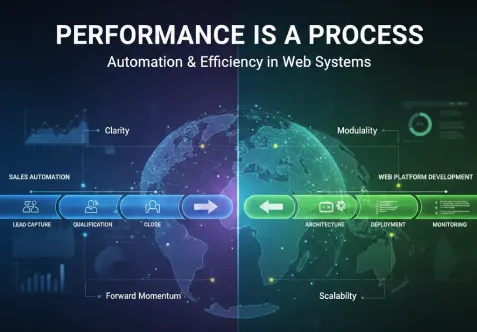
Web systems that work well don't just happen by chance. They are the consequence of careful planning, strict execution, and a constant focus on automation and efficiency. Just like modern sales teams use automated pipelines to make sure prospects move seamlessly from initial contact to close, we build online platforms with the same goal in mind: to reduce friction, improve flow, and grow smartly.
There is a well-organized system working quietly in the background of every fast, dependable, and scalable web platform. Here's how we make platforms that work all the time and in a way that can be counted on.
Performance Is a Process, Not a Feature
A lot of teams think that you "optimize" performance at the end of a project. In fact, performance is a part of every choice from the very beginning.
We think of platform development as an automated pipeline:
Every step has a clear goal.
Every handoff is set in stone.
Early on, bottlenecks are found.
We try to do as little manual effort as possible.
This method is similar to how current sales pipeline automation boosts conversion rates by making things clear, consistent, and moving forward. When used in web development, this leads to faster builds, fewer failures, and platforms that grow without any problems.
Architecture That Works Well and Can Grow
A good architectural plan is what makes every high-performance online platform work. Before we write any code, we figure out how data, users, and systems will move throughout the platform.
The most important architectural concepts we follow are:
Parts that are modular and based on services
Frontend, backend, and integrations are all clearly separate.
Infrastructure that can grow with demand
Few dependencies that lower the chances of failure
Automated sales funnels keep leads from getting stalled, while modular architecture keeps performance problems from spreading across the whole platform. Each part works well and accomplishes its duty on its own.
Automation is the most important part of the build
The major difference between mediocre systems and high-performance ones is automation.
We automate wherever speed and consistency are important, based on automation methods utilized in modern business:
Setting up infrastructure
Deployments of applications
Quality checks and testing
Watching and sending alerts
This gets rid of mistakes made by people and makes sure that the same results happen every time. Automation lets the platform proceed from development to deployment without any problems, instead of relying on manual steps that slow things down. This is similar to how a well-automated pipeline sends leads through stages without any delays.
Decisions about performance based on data
Visibility is important for high-performance platforms. You can't make something better if you can't see it.
We set up analytics and monitoring early so we can keep an eye on:
How long it takes for a page to load
How fast API responses are
Patterns of how users act
How the system uses resources
This is similar to how sales automation solutions show you what's going on in your pipeline by pointing out drop-offs, slow stages, and chances to make things better. For online platforms, these insights help us improve speed before users even notice anything is wrong.
Building for Real-World Traffic, Not Best-Case Scenarios
A lot of platforms work well in testing but not so well in the real world. We plan for what is genuine.
Our plan for performance includes:
Traffic spikes
Where users are located
Sessions at the same time
Limits on third-party integration
We make sure the system can handle stress by putting it through stress tests and emulating real-world usage patterns. Our platforms are meant to handle traffic increase without any problems, just like automated pipelines are built to handle more leads.
Safety and Performance Work Together
A platform that works well must also be safe. Problems with security cause downtime, which hurts performance.
We provide security to the build process by
Enforcing access with the least amount of privilege
Protecting APIs and integrations
Updates and patches that happen automatically
Looking for strange things
This proactive strategy stops problems that slow down platforms and erode trust. It's not only about how fast you are; it's also about how reliable you are.
Ongoing Improvement After Launch
The launch isn't the end; it's the beginning.
Platforms with high performance are always changing. After the launch, we:
Keep an eye on how people use it
Find out where performance is slowing down
Make code and infrastructure better
Make workflows better based on real data
This cycle of continuous improvement is like how sales teams make automated pipelines better over time by changing triggers, workflows, and follow-ups to get better outcomes. The same idea applies to digital platforms: improve what works, correct what doesn't, and keep going.
Why This Method Works
We get the following results by treating platform development like a pipeline that runs automatically and is based on performance:
Load times are shorter.
More time online
Easier to scale
Less work to keep up
More significantly, we give businesses platforms that help them expand instead of holding them back.
Last Thoughts
A system that is created for flow, automation, and visibility is what makes a high-performance online platform work. We make platforms that not only function, but work really well by using the same ideas that make automation pipelines succeed: clarity, consistency, and optimization.
There is no magic about performance. It's designed.